Boating Accident Lawyer

Boating Accident Lawyer

Last Updated: February 2026

Key Takeaways

The U.S. Coast Guard reports approximately 636 boating fatalities and over 2,200 injuries annually in recreational boating accidents, with operator inexperience and alcohol use as the leading contributing factors. Boating accident claims involve a unique intersection of state tort law, federal admiralty law, and statutes like the Jones Act (46 U.S.C. § 30104), making specialized legal representation essential. The statute of limitations for maritime personal injury claims is generally three years from the date of injury.

Boating accidents can cause devastating injuries, permanent disabilities, and wrongful death. Unlike car accidents on public roads, boating accident claims involve a unique intersection of state negligence law, federal maritime law, and Coast Guard regulations that most personal injury attorneys rarely encounter. If you or a loved one has been injured in a boating accident, you need a lawyer who understands these complexities and will fight to recover the full compensation you deserve.

At Maxx Compensation, attorney Charles C. Teale represents boating accident victims and their families across the United States. We handle every type of recreational and commercial boating accident case, from jet ski collisions to commercial vessel disasters. Call 877-462-9952 for a free, no-obligation consultation, or visit our free case evaluation page to get started today.

Why Do Boating Accident Cases Require Specialized Legal Knowledge?

Boating accident claims are fundamentally different from typical personal injury cases. The legal framework governing waterway injuries draws from multiple overlapping sources of law, including state tort law, federal admiralty and maritime law, the Jones Act, the Longshore and Harbor Workers’ Compensation Act, and regulations issued by the United States Coast Guard. Determining which laws apply to your case depends on factors such as where the accident occurred, whether the vessel was commercial or recreational, your status on the vessel (passenger, crew member, or third party), and the type of waterway involved.

An attorney without experience in maritime and boating accident law may miss critical legal theories, file in the wrong jurisdiction, or fail to identify all liable parties. Charles C. Teale and the team at Maxx Compensation have the knowledge and resources to navigate these challenges and build a strong case on your behalf.

What Are the Most Common Types of Boating Accidents?

Boating accidents take many forms, and each type presents distinct legal and factual issues. The most common types of boating accidents include:

Collision with Another Vessel

Boat-on-boat collisions are among the most frequently reported boating accidents. These crashes can occur when operators fail to maintain a proper lookout, violate navigational rules of the road, operate at excessive speed, or attempt dangerous passing maneuvers. Collisions between vessels often result in severe trauma to passengers and operators, including ejection from the boat, blunt force injuries, and drowning.

Collision with Fixed Objects

Boats can strike docks, piers, bridge abutments, channel markers, rocks, sandbars, and submerged debris. These accidents frequently occur in low-visibility conditions, unfamiliar waters, or when operators are distracted or impaired. Fixed-object collisions can cause catastrophic damage to the vessel and serious injuries to everyone aboard.

Capsizing and Swamping

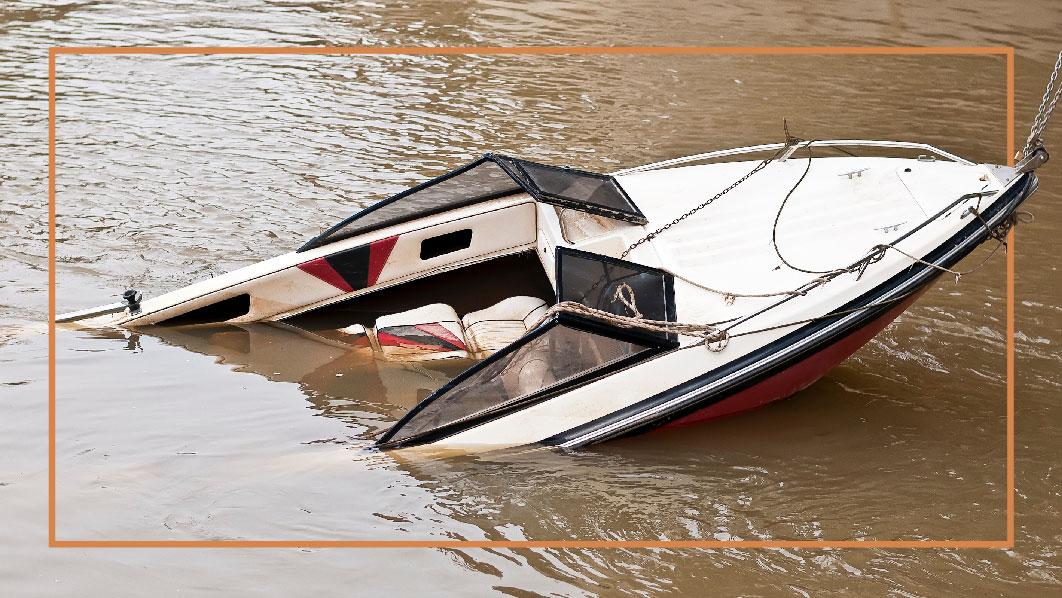
When a boat overturns or takes on water and sinks, the results can be fatal. Capsizing can be caused by overloading, improper weight distribution, sudden turns at high speed, large wakes from other vessels, or deteriorating weather conditions. Passengers thrown into the water face the immediate risks of drowning, hypothermia, and being struck by the propeller or other vessels in the area.

Falls Overboard

Passengers and crew members fall overboard due to sudden maneuvers, slippery deck surfaces, inadequate railings, rough water conditions, or intoxication. Falls overboard are particularly dangerous because the victim may be struck by the propeller, may not be noticed immediately, or may be unable to stay afloat due to injuries sustained during the fall.

Jet Ski and Personal Watercraft Accidents

Personal watercraft such as jet skis, WaveRunners, and Sea-Doos are involved in a disproportionate number of boating injuries relative to their size. These vessels are fast, highly maneuverable, and frequently operated by inexperienced riders. Jet ski accidents commonly involve collisions with other watercraft, collisions with swimmers, ejection at high speed, and wake-jumping injuries.

Propeller Strike Injuries

Contact with a spinning boat propeller can cause amputations, deep lacerations, and fatal injuries within seconds. Propeller strikes occur when swimmers, divers, or fallen passengers come into contact with an operating or idling propeller. These accidents often result in permanent, life-altering injuries.

Tubing, Waterskiing, and Towed Water Sport Accidents

Recreational towed water sports carry significant injury risks. Participants can be dragged into the path of other boats, struck by the tow vessel, injured by the tow rope, or slammed into the water at high speed. The operator of the tow vessel has a duty to maintain a safe speed, keep a proper lookout, and designate an observer to watch the person being towed.

Fire and Explosion

Boats carry flammable fuel, and engine compartments can accumulate explosive vapors. Fuel leaks, electrical malfunctions, improper fueling procedures, and failure to ventilate engine compartments before starting the motor can all lead to onboard fires and explosions. Victims of boat fires often suffer severe burn injuries requiring extensive medical treatment, skin grafts, and long-term rehabilitation.

Commercial Vessel Accidents

Workers on commercial fishing boats, tugboats, barges, ferries, and cargo vessels face unique hazards including heavy equipment, extreme weather, long working hours, and dangerous cargo. Commercial vessel accidents are often governed by federal maritime law and may involve claims under the Jones Act or the Longshore and Harbor Workers’ Compensation Act.

What Are the Most Common Causes What Are the Most What Are the Most of Boating Accidents???

Understanding the cause of a boating accident is essential for establishing liability and proving negligence. According to the U.S. Coast Guard’s annual Recreational Boating Statistics report, which recorded 636 fatalities, 2,222 injuries, and approximately $63 million in property damage in its most recent reporting year, the leading causes of boating accidents include the following:

Operator Inexperience

Operator inexperience is consistently identified as one of the top contributing factors in boating accidents nationwide. Unlike automobiles, boats do not require a driver’s license in many states, and boater education requirements vary widely. Inexperienced operators may not understand navigational rules, may misjudge distances and speeds, may not know how to react to changing weather or water conditions, and may be unfamiliar with the handling characteristics of the vessel they are operating.

Many states allow boat rentals to individuals with no prior boating experience and minimal or no safety instruction. Rental companies that fail to provide adequate training and safety briefings may bear liability when their customers cause accidents.

Alcohol and Drug Use

Operating a boat under the influence of alcohol or drugs is illegal under both federal and state law. The federal standard for boating under the influence (BUI), established under 46 U.S.C. § 2302(c), is a blood alcohol concentration of 0.08% or higher, the same as the standard for driving a car. However, the effects of alcohol are amplified on the water due to sun exposure, wind, wave motion, engine vibration, and the physical exertion of boating activities. These environmental stressors cause fatigue and impairment to set in faster and at lower blood alcohol levels than they would on land.

Alcohol impairs judgment, slows reaction time, reduces coordination, and affects vision and balance. It is a leading contributing factor in fatal boating accidents year after year.

Excessive Speed

There is no universal speed limit on most waterways, but every boat operator is required to travel at a safe speed given the conditions. Factors that determine a safe speed include visibility, traffic density, the maneuverability of the vessel, wind and wave conditions, water depth, and proximity to navigational hazards. Operators who travel at excessive speed have less time to react to dangers and cause more severe injuries when collisions occur.

Operator Inattention and Distraction

Failing to maintain a proper lookout is a violation of Rule 5 of the U.S. Inland Navigation Rules (33 U.S.C. § 2005) and the International Regulations for Preventing Collisions at Sea (COLREGS). Distracted boating, including using a cell phone, adjusting electronics, or socializing with passengers instead of watching the water, is a leading cause of boating accidents. Unlike roads with lanes and traffic signals, waterways rely heavily on operator vigilance to prevent collisions.

Equipment and Mechanical Failure

Boats contain complex mechanical, electrical, and fuel systems that require regular maintenance and inspection. Equipment failures that cause boating accidents include engine failure, steering system malfunction, throttle failure, electrical system faults, hull breaches, and failed navigation equipment. When a boating accident is caused by defective equipment, the boat manufacturer, engine manufacturer, parts supplier, or maintenance provider may be held liable under product liability law.

Weather Conditions

Sudden storms, high winds, fog, lightning, and rough water can create extremely dangerous boating conditions. Responsible operators monitor weather forecasts, carry proper safety equipment, and return to shore when conditions deteriorate. Operators who launch in the face of severe weather warnings or who fail to take shelter when conditions worsen may be liable for resulting injuries.

Overloading and Improper Loading

Every boat has a maximum capacity for passengers and cargo, indicated on the capacity plate. Exceeding this capacity or distributing weight unevenly can cause a boat to become unstable, take on water, or capsize. Overloading is a particularly common factor in small boat accidents.

Violation of Navigation Rules

The U.S. Inland Navigation Rules establish right-of-way rules, required signals, and safe operating procedures for vessels on inland waterways. Operators who violate these rules, such as by failing to yield to the stand-on vessel, operating on the wrong side of a channel, or failing to display proper navigation lights, create dangerous conditions and may be liable for resulting accidents.

How Does Maritime Law Apply to Boating Accidents?

Maritime law, also known as admiralty law, is a body of federal law that governs activities on navigable waters of the United States. Maritime law has its origins in centuries of seafaring tradition and has been codified through federal statutes, international treaties, and court decisions. Understanding how maritime law applies to boating accidents is critical because it can affect where your case is filed, which laws govern liability, what damages are available, and how statutes of limitations are calculated.

When Does Maritime Law Apply?

Maritime law generally applies when a boating accident occurs on navigable waters and has a significant connection to traditional maritime activity. Navigable waters include the oceans, the Great Lakes, major rivers, bays, harbors, and other waterways that are used or susceptible to use in interstate or foreign commerce. Many recreational boating accidents on lakes, rivers, and coastal waters fall under maritime jurisdiction.

When maritime law applies, it may preempt or supplement state law. This can affect the available theories of liability, the calculation of damages, comparative fault rules, and the applicable statute of limitations. In some cases, maritime law provides broader remedies than state law; in others, it may impose limitations that do not exist under state law.

The Jones Act

The Jones Act (46 U.S.C. § 30104) is a federal statute that gives seamen, meaning crew members of vessels, the right to sue their employers for injuries caused by negligence. To qualify as a seaman under the Jones Act, a worker must contribute to the function of a vessel or the accomplishment of its mission, and must have a substantial connection to a vessel in navigation.

The Jones Act is significant because it provides remedies that are not available under state workers’ compensation systems. Unlike workers’ compensation, which provides limited benefits regardless of fault, the Jones Act allows injured seamen to recover full compensatory damages, including pain and suffering, if they can prove that their employer’s negligence contributed in any way to their injury. The burden of proof under the Jones Act is lower than in ordinary negligence cases. The injured seaman need only show that the employer’s negligence played any part, even the slightest, in causing the injury.

In addition to negligence claims under the Jones Act, injured seamen may also have claims for maintenance and cure (a no-fault obligation of the vessel owner to provide basic living expenses and medical treatment until the seaman reaches maximum medical improvement) and for unseaworthiness (a strict liability claim that the vessel was not reasonably fit for its intended use).

The Longshore and Harbor Workers’ Compensation Act

The Longshore and Harbor Workers’ Compensation Act (LHWCA) provides compensation to maritime workers who are injured on navigable waters or in adjoining areas such as docks, piers, and terminals, but who do not qualify as seamen under the Jones Act. Workers covered by the LHWCA include longshoremen, harbor workers, ship repairers, and shipbuilders. The LHWCA provides scheduled benefits for lost wages and medical treatment, but injured workers may also have third-party claims against negligent parties other than their employer.

The Death on the High Seas Act

The Death on the High Seas Act (DOHSA, 46 U.S.C. §§ 30301–30308) provides a cause of action for wrongful death when a death is caused by a wrongful act, neglect, or default occurring on the high seas beyond three nautical miles from the shore of the United States. DOHSA limits recovery to pecuniary (financial) losses, which may include lost wages, lost support, lost services, and funeral expenses. It does not allow recovery for non-economic damages such as pain and suffering or loss of companionship, although some courts have expanded the scope of recoverable damages in recent years.

Who Is Liable in a Boating Accident Case?

Determining who is legally responsible for a boating accident requires a thorough investigation of the facts and applicable law. Multiple parties may share liability depending on the circumstances. Potentially liable parties in boating accident cases include:

  • The boat operator: Operators who are negligent, reckless, intoxicated, or in violation of navigation rules may be held personally liable for injuries they cause.
  • The boat owner: Boat owners may be liable if they entrusted their vessel to an incompetent or unlicensed operator, if they failed to maintain the vessel in a safe condition, or under vicarious liability theories if they allowed someone to use their boat.
  • Boat rental companies: Companies that rent boats to inexperienced operators without adequate safety training, that rent defective equipment, or that fail to maintain their fleet may be held liable for resulting injuries.
  • Charter boat operators and tour companies: These commercial operators owe a heightened duty of care to their passengers and may be liable for negligent operation, failure to provide safety equipment, and failure to cancel trips in dangerous weather.
  • Employers: Employers of crew members may be liable under the Jones Act, general maritime law, or the LHWCA for injuries to their employees.
  • Boat and equipment manufacturers: When a boating accident is caused by a defective product, such as a defective hull design, a faulty engine component, or a malfunctioning steering system, the manufacturer may be held liable under product liability law.
  • Government entities: Government agencies responsible for maintaining navigable waterways, posting hazard markers, maintaining locks and dams, or overseeing marina operations may bear liability if their negligence contributes to an accident. Claims against government entities are subject to special notice requirements and shorter filing deadlines.
  • Other boaters: Third-party operators whose negligence contributed to the accident may be held liable for their share of the damages.
  • Marina and dock operators: Marinas that fail to maintain safe conditions, that create hazardous wake zones, or that allow dangerous operations in their waters may bear liability.

In many boating accident cases, more than one party shares fault. Depending on the jurisdiction, comparative or contributory negligence rules will determine how fault is allocated and how damages are apportioned among the responsible parties.

What Injuries Are Caused by Boating Accidents?

Boating accidents can cause a wide range of injuries, from minor cuts and bruises to catastrophic, life-threatening trauma. The most common injuries seen in boating accident cases include:

  • Drowning and near-drowning: Victims who are submerged or unable to breathe may suffer fatal drowning or non-fatal drowning resulting in brain damage from oxygen deprivation, lung damage, and other complications.
  • Traumatic brain injuries: Head trauma from collisions, falls, and ejection from the vessel can cause concussions, contusions, and severe traumatic brain injuries with permanent cognitive, behavioral, and physical effects.
  • Spinal cord injuries: Impacts to the back and neck can fracture or dislocate vertebrae and damage the spinal cord, potentially resulting in partial or complete paralysis.
  • Broken bones and fractures: The violent forces involved in boating collisions frequently cause fractures to the arms, legs, ribs, pelvis, and facial bones.
  • Lacerations and propeller injuries: Contact with boat propellers, broken fiberglass, metal fittings, and sharp debris can cause deep, disfiguring lacerations and traumatic amputations.
  • Burns: Fires, explosions, and contact with hot engine components can cause first-, second-, and third-degree burn injuries that require skin grafts and extensive reconstructive surgery.
  • Hypothermia: Prolonged exposure to cold water can cause dangerous drops in body temperature, leading to cardiac arrest, organ failure, and death.
  • Soft tissue injuries: Sprains, strains, torn ligaments, and disc herniations are common in boating accident victims, particularly those involved in high-speed collisions or sudden impacts.
  • Post-traumatic stress disorder: The psychological trauma of a boating accident, especially one involving drowning, severe injury, or the death of a companion, can cause lasting PTSD, anxiety, depression, and phobias.

Many boating accident injuries require emergency medical treatment, surgery, extended hospitalization, and months or years of rehabilitation. Some injuries result in permanent disability that prevents the victim from returning to work or living independently. In the most tragic cases, boating accidents result in wrongful death, leaving families to cope with the sudden and preventable loss of a loved one.

What Compensation Is Available in Boating Accident Cases?

Victims of boating accidents may be entitled to recover compensation for the full extent of their injuries and losses. The types of damages available in a boating accident case depend on the applicable law (state tort law, maritime law, or a combination), the severity of the injuries, and the facts of the case. Potentially recoverable damages include:

Economic Damages

  • Medical expenses: All costs of past and future medical treatment, including emergency room visits, hospitalizations, surgeries, medications, diagnostic testing, physical therapy, occupational therapy, assistive devices, and home modifications.
  • Lost wages: Income lost during recovery, including salary, hourly wages, bonuses, commissions, and benefits.
  • Loss of earning capacity: If injuries prevent the victim from returning to their previous occupation or from working at all, they may recover compensation for the difference in earning capacity over their remaining working life.
  • Property damage: The cost to repair or replace a damaged boat, personal belongings, and other property.
  • Out-of-pocket expenses: Transportation to medical appointments, home care services, childcare necessitated by the injury, and other expenses caused by the accident.

Non-Economic Damages

  • Pain and suffering: Physical pain endured as a result of the injuries and medical treatment.
  • Emotional distress: Anxiety, depression, PTSD, fear, and other psychological effects of the accident and injuries.
  • Loss of enjoyment of life: The inability to participate in hobbies, recreational activities, and other aspects of life that the victim enjoyed before the accident.
  • Disfigurement and scarring: Compensation for permanent physical changes caused by the injuries.
  • Loss of consortium: The impact of the injuries on the victim’s relationship with their spouse, including loss of companionship, affection, and intimacy.

Wrongful Death Damages

When a boating accident causes the death of a victim, surviving family members may bring a wrongful death claim to recover damages including funeral and burial expenses, loss of the decedent’s future income and benefits, loss of parental guidance and support, loss of companionship and consortium, and in some jurisdictions, pain and suffering experienced by the decedent before death.

Punitive Damages

In cases involving particularly egregious conduct, such as operating a boat while severely intoxicated or engaging in reckless behavior with willful disregard for passenger safety, the court may award punitive damages. Punitive damages are designed to punish the wrongdoer and deter similar conduct in the future. They are not available in every case and are subject to legal standards that vary by jurisdiction.

What Should You Do After a Boating Accident?

The steps you take immediately after a boating accident can significantly affect both your health and your legal rights. If you are involved in a boating accident, take the following steps:

  1. Ensure safety and seek medical attention: Your first priority is the safety of everyone involved. Move to a safe location if possible, administer first aid, deploy life jackets and other safety equipment, and call for emergency assistance. Even if your injuries seem minor, seek medical evaluation as soon as possible. Some serious injuries, including traumatic brain injuries and internal bleeding, may not produce obvious symptoms immediately.
  2. Report the accident: Federal law requires boat operators to file an accident report with the state boating authority when an accident results in death, disappearance, injuries requiring medical treatment beyond first aid, or property damage above a threshold amount (which varies by state). Many states also require immediate notification to local law enforcement or the Coast Guard for serious accidents. Failing to report an accident can result in penalties and can harm your legal claim.
  3. Document the scene: If it is safe to do so, take photographs and video of the accident scene, the vessels involved, visible damage, weather and water conditions, and any visible injuries. Record the names, contact information, and insurance information of all operators and vessel owners involved. Get the names and contact information of any witnesses.
  4. Preserve evidence: Do not repair or dispose of the damaged vessel or any equipment that may have contributed to the accident. Preserve all clothing worn during the accident, any safety equipment used, and any electronic devices that may contain relevant data such as GPS coordinates, speed logs, or communications.
  5. Avoid making statements: Do not admit fault or make detailed statements about the accident to other parties, insurance adjusters, or on social media. Anything you say can be used against you in a legal proceeding. Stick to the facts when speaking with law enforcement and medical personnel.
  6. Contact a boating accident lawyer: Boating accident cases involve legal complexities that can affect your right to compensation. Contact an experienced boating accident attorney as soon as possible to protect your rights, preserve evidence, and begin building your case.

How Does Maxx Compensation Investigate Boating Accident Claims?

At Maxx Compensation, we conduct thorough investigations to build the strongest possible case for our clients. Our investigation process may include:

  • Reviewing Coast Guard accident reports and state boating authority records
  • Inspecting the vessels involved and retaining marine engineering experts to analyze mechanical and structural failures
  • Obtaining and analyzing GPS data, depth finder records, and electronic navigation logs
  • Reviewing weather and water condition data from the National Weather Service and NOAA
  • Interviewing witnesses, passengers, and first responders
  • Reviewing the operator’s boating history, training records, and any prior violations or accidents
  • Investigating whether alcohol or drug impairment was a factor through toxicology reports and BUI records
  • Retaining accident reconstruction experts to determine the sequence of events and the cause of the accident
  • Reviewing medical records and consulting with medical experts to document the full extent of injuries and future treatment needs
  • Identifying all potentially liable parties and all applicable insurance policies

How Long Do You Have to File a Claim What Is the for Boating Accident Claims??

Every boating accident claim is subject to a filing deadline known as the statute of limitations. If you fail to file your claim before the deadline expires, you will lose your right to recover compensation. The applicable statute of limitations depends on the type of claim and the law that governs it:

  • State personal injury claims: Most states have a statute of limitations of two to three years for personal injury claims, but some states have shorter or longer deadlines. The clock typically begins running on the date of the accident.
  • Maritime personal injury claims: Under general maritime law, the statute of limitations for personal injury claims is three years from the date of the injury.
  • Jones Act claims: The statute of limitations for Jones Act negligence claims is three years from the date of injury.
  • Wrongful death claims: State wrongful death statutes of limitations vary, typically ranging from one to three years. Under general maritime law, the deadline for wrongful death claims is three years. Under the Death on the High Seas Act, the deadline is also three years.
  • Claims against government entities: Claims against federal, state, or local government agencies are often subject to much shorter notice deadlines, sometimes as short as 60 to 180 days after the accident.

Because the deadlines vary depending on the applicable law and the parties involved, it is essential to consult with a boating accident lawyer as soon as possible to ensure your claims are filed on time.

How Do Boating Accident Claims Differ from Car Accident Claims?

Many people assume that a boating accident claim works the same way as a car accident claim. While there are some similarities, there are important differences that can significantly affect your case:

  • Insurance coverage: Unlike auto insurance, boat insurance is not mandatory in most states. Many boat owners carry no insurance at all, or carry policies with low limits. This can complicate the process of recovering compensation and may require pursuing the boat owner’s personal assets.
  • Applicable law: Car accidents are governed by state traffic laws and tort law. Boating accidents may be governed by federal maritime law, state boating regulations, or both, depending on where the accident occurred and the parties involved.
  • Regulatory framework: Motor vehicles are subject to comprehensive licensing, registration, and safety inspection requirements. Boating regulations are generally less stringent, with many states requiring no operator’s license and no periodic safety inspections for recreational vessels.
  • Evidence preservation: Unlike roads, waterways do not have traffic cameras, lane markings, or skid marks. Evidence in boating accidents is often more difficult to preserve because it may be submerged, dispersed by currents, or destroyed by the elements.
  • Multiple jurisdictions: A boating accident may involve federal, state, and sometimes international jurisdictions, particularly when the accident occurs on boundary waters, interstate waterways, or the open sea.

Frequently Asked Questions About Boating Accident Claims

Do I need a lawyer for a boating accident?

While you are not legally required to hire a lawyer, boating accident cases involve legal complexities that make professional representation highly advisable. The intersection of state and federal law, maritime regulations, and the involvement of multiple potentially liable parties create challenges that are difficult to navigate without legal experience. An experienced boating accident lawyer can identify all available sources of compensation, handle communications with insurance companies, preserve critical evidence, and advocate for the full value of your claim. Most boating accident attorneys, including Maxx Compensation, work on a contingency fee basis, meaning you pay no upfront fees and owe nothing unless we recover compensation for you.

What is the difference between BUI and DUI?

BUI (boating under the influence) and DUI (driving under the influence) are similar offenses that prohibit operating a vehicle or vessel while impaired by alcohol or drugs. Both use a blood alcohol concentration threshold of 0.08% in most jurisdictions. However, BUI enforcement is handled by different agencies (typically state wildlife officers, marine patrol, or the Coast Guard), and the penalties may differ from those for DUI. In a civil boating accident case, evidence that the operator was under the influence of alcohol or drugs is strong evidence of negligence and may support claims for punitive damages.

Can I file a boating accident claim if I was a passenger?

Yes. Passengers who are injured in boating accidents have the right to file claims against the boat operator, the boat owner, and any other party whose negligence caused the accident. Passengers are generally not considered to share fault for the accident unless they engaged in conduct that contributed to their own injuries, such as refusing to wear a life jacket or interfering with the operator. As a passenger, you may have claims against your own boat’s operator, the operator of another vessel involved in the accident, the boat owner, a rental company, or a manufacturer of defective equipment.

What if the boat owner does not have insurance?

If the at-fault boat owner does not carry liability insurance, recovering compensation becomes more challenging but is not impossible. Your attorney can pursue a claim directly against the boat owner’s personal assets, including real estate, bank accounts, and other property. In some cases, other parties may share liability and carry insurance, such as a rental company, a marina, a manufacturer, or an employer. An experienced boating accident lawyer will identify all potential sources of recovery to maximize your compensation.

How long does a boating accident case take to resolve?

The timeline for resolving a boating accident case varies significantly depending on the complexity of the case, the severity of the injuries, the number of parties involved, and whether the case settles or goes to trial. Simpler cases with clear liability and moderate injuries may settle within several months. Complex cases involving multiple parties, disputed liability, serious injuries, or maritime law issues may take one to three years or longer to resolve. At Maxx Compensation, we work efficiently to resolve your case as quickly as possible while ensuring that you receive the full compensation you deserve.

What compensation can I receive for a boating accident?

The compensation available in a boating accident case depends on the specific facts and applicable law, but may include medical expenses (past and future), lost wages and loss of earning capacity, pain and suffering, emotional distress, property damage, loss of enjoyment of life, disfigurement, and loss of consortium. In wrongful death cases, surviving family members may recover funeral expenses, lost financial support, and loss of companionship. In cases involving egregious misconduct, punitive damages may also be available.

Can I sue a boat rental company?

Yes, boat rental companies can be held liable for boating accidents in several circumstances. These include renting a boat to a person who is clearly inexperienced and providing no training or safety instruction, renting a vessel that is defective or poorly maintained, failing to provide required safety equipment such as life jackets and fire extinguishers, and failing to warn customers about known hazards in the area. Rental companies have a duty to ensure their vessels are safe and that their customers have at least a basic understanding of how to operate the vessel safely.

What should I do if a family member died in a boating accident?

If you have lost a family member in a boating accident, we extend our deepest condolences. You may have the right to file a wrongful death claim to recover compensation for funeral expenses, loss of the decedent’s income and benefits, loss of companionship, and other damages. It is important to act quickly because wrongful death claims are subject to statutes of limitations, and evidence from the accident scene can be lost or degraded over time. Contact Maxx Compensation at 877-462-9952 for a compassionate and confidential consultation about your family’s legal options.

Why Choose Maxx Compensation for Your Boating Accident Case?

At Maxx Compensation, we understand the physical, emotional, and financial devastation that boating accidents cause. Attorney Charles C. Teale is committed to holding negligent boat operators, owners, rental companies, and manufacturers accountable for the harm they cause. When you work with our firm, you can expect:

  • Personalized attention: We treat every client as an individual, not a case number. You will work directly with your attorney and receive regular updates on the progress of your case.
  • Thorough investigation: We invest the time and resources necessary to uncover the facts, identify all liable parties, and build the strongest possible case on your behalf.
  • Knowledge of maritime law: We understand the legal complexities that make boating accident cases unique, including federal maritime law, the Jones Act, and Coast Guard regulations.
  • No upfront costs: We handle boating accident cases on a contingency fee basis. You pay no attorney fees unless we recover compensation for you.
  • Aggressive advocacy: We are prepared to take your case to trial if the insurance company or the at-fault party refuses to offer fair compensation.

Contact a Boating Accident Lawyer Today

If you or someone you love has been injured in a boating accident, do not wait to seek legal help. Evidence can be lost, witnesses’ memories fade, and statutes of limitations can expire. The sooner you contact Maxx Compensation, the sooner we can begin protecting your rights and building your case.

Call attorney Charles C. Teale at 877-462-9952 for a free, no-obligation consultation. You can also submit your information through our free case evaluation form, and a member of our team will contact you promptly. We are available to take your call and answer your questions. There is no fee unless we win your case.

Find a Boating Accident Lawyer in Your State

Maxx Compensation represents boating accident victims across all 50 states. Select your state to learn about the laws and legal options specific to your location: